
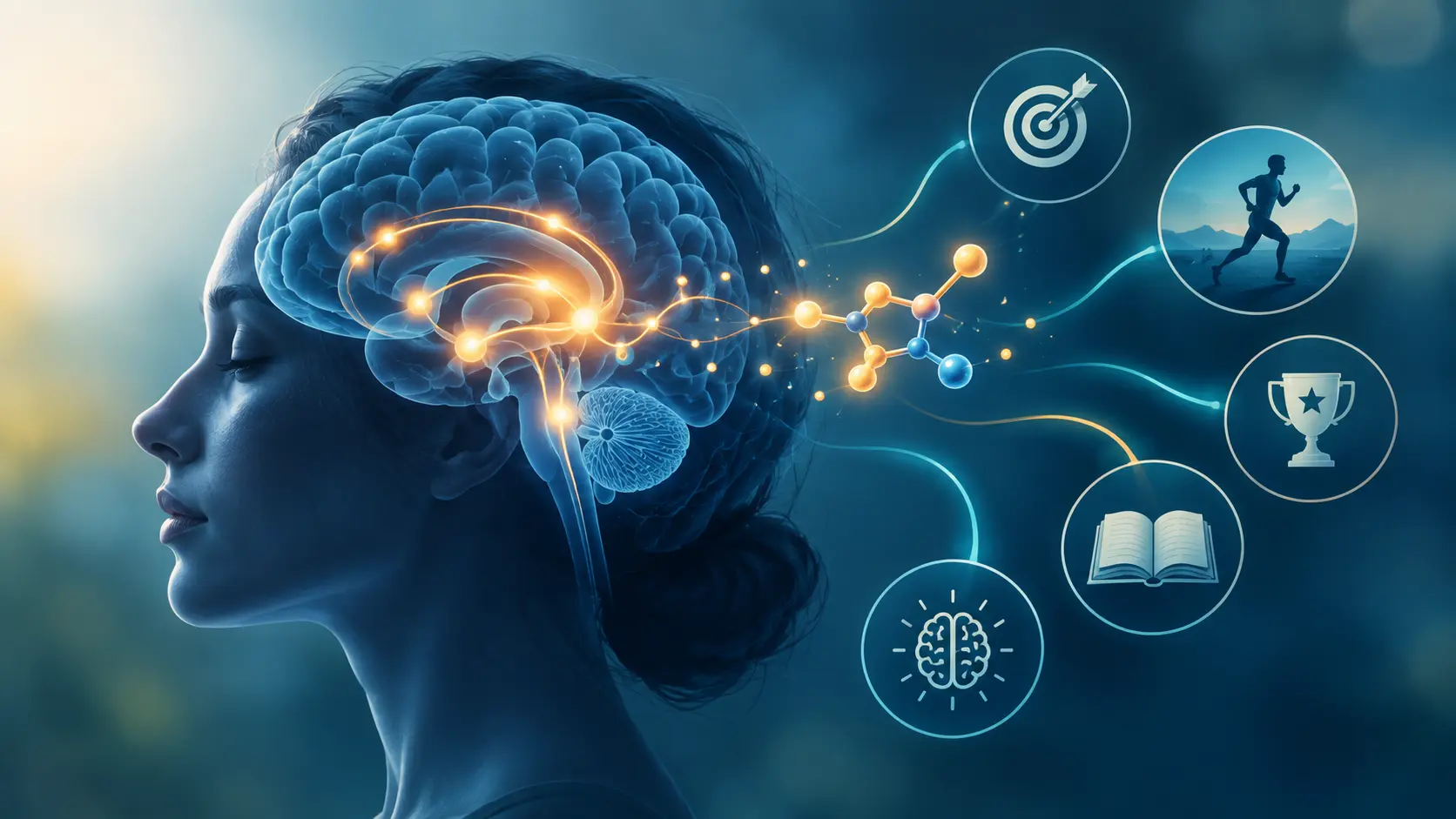
You have probably heard dopamine described as the brain’s “feel good chemical.” You see that explanation everywhere, especially when people talk about motivation, social media, or productivity. But dopamine is doing much more than simply making us feel good.
So, what does dopamine do?
It is involved in motivation, learning, movement, reward, and the way we respond to things that might be important or worth pursuing
This is where dopamine gets interesting in everyday life. It can help explain why starting a difficult task can feel harder than checking your phone, why some habits become automatic, and why we sometimes keep looking for another quick source of stimulation.
If you’ve ever wondered what does dopamine do and why it seems to influence motivation, focus, and habits, the answer is more interesting than the idea that dopamine is simply a “pleasure chemical.”
What Is Dopamine?
So, what does dopamine mean ? Dopamine is a neurotransmitter, which basically means it is one of the chemical messengers that helps nerve cells communicate with each other.
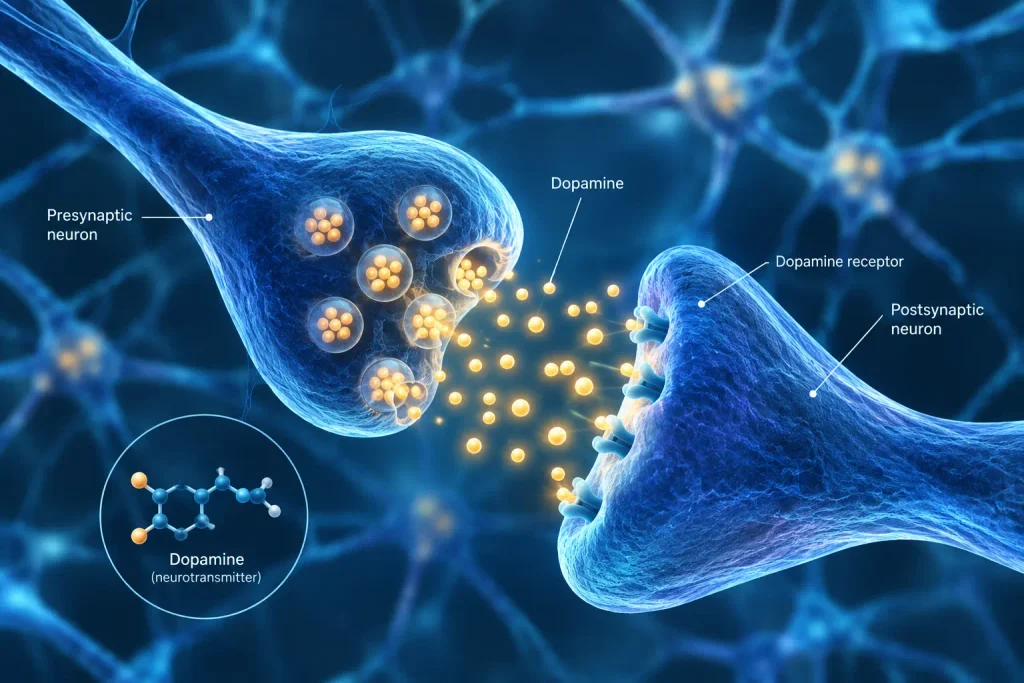
Your brain produces dopamine in several areas, including the substantia nigra and the ventral tegmental area. From there, dopamine is involved in different brain pathways that have different functions.
This is important because dopamine does not have just one job. Some dopamine pathways are involved in movement, while others are involved in motivation, learning, and how we respond to rewards.
So when you hear people talking about dopamine, it is worth remembering that they are talking about a system with several different roles, not a single chemical responsible for one particular feeling.
What Does Dopamine Do in the Brain?
To understand what dopamine does in the brain, it helps to look at its different roles, it helps to look at its different roles. Dopamine is involved in several processes, and its effects depend on the brain pathways and circuits involved.
Dopamine and Motivation
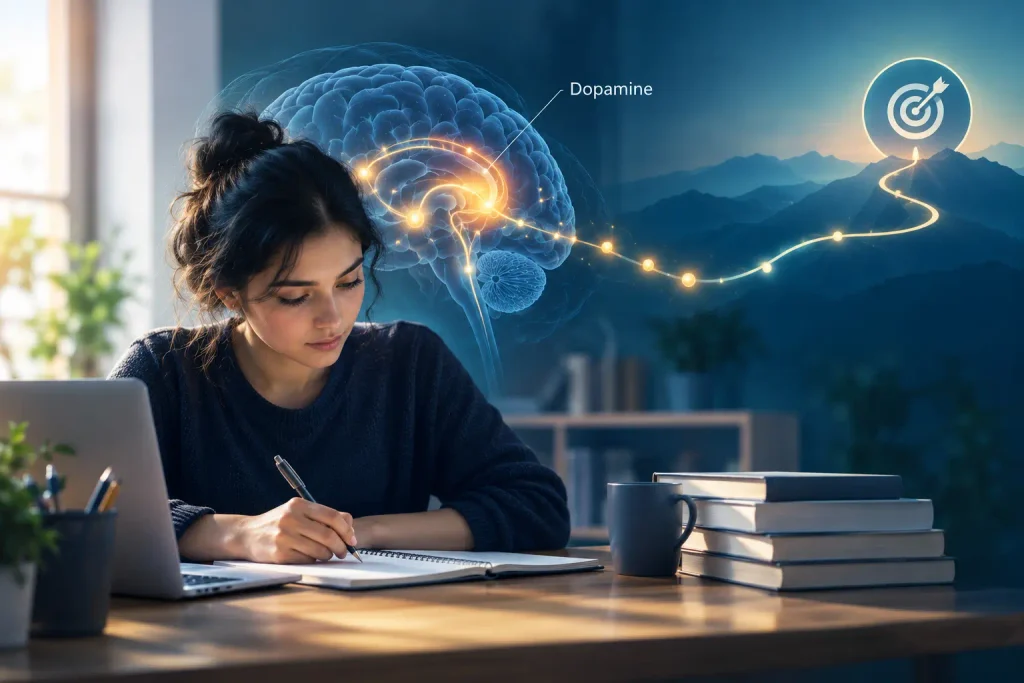
Dopamine is closely involved in motivation. It helps your brain respond to things that may be worth pursuing and can influence how much effort you are willing to put toward a goal.
One useful distinction in dopamine research is the difference between wanting something and actually enjoying it. These two experiences are not necessarily the same. You can strongly want something without enjoying it as much as you expected, and you can enjoy something without being strongly motivated to pursue it again.
This is one reason dopamine is often discussed in relation to motivation rather than simply pleasure. It is involved in the processes that help us pursue goals and respond to rewards.
Dopamine and Reward Prediction
Dopamine is also involved in how the brain responds to rewards that are better or worse than expected.
Imagine that you try something for the first time and it turns out to be much better than you expected. Your brain can respond differently than it would if the experience was exactly what you expected.
The same thing can happen in the opposite direction. If you expected a reward and it does not happen, the dopamine signal can decrease.
Researchers often describe this difference between what was expected and what actually happened as a reward prediction error.
This process helps the brain learn from experience. It can help us recognize which actions, situations, or cues are likely to lead to rewarding outcomes and which ones are not.
Dopamine and Learning
Dopamine also plays an important role in learning. When something turns out better or worse than we expected, the brain can use that information to update what we expect in the future.
For example, imagine you study for an exam and get a better result than you expected. That positive outcome can help reinforce the connection between studying and getting a good result.
Over time, these kinds of experiences can influence which behaviors we are more likely to repeat. This is one reason dopamine is closely connected to learning and reinforcement.
In simple terms, dopamine helps the brain learn from what happens after we do something.
Dopamine and Movement
Dopamine is also important for movement. Certain dopamine producing neurons in the brain are involved in the circuits that help control movement.
This becomes especially clear in Parkinson’s disease, where dopamine producing neurons in a part of the brain called the substantia nigra are gradually lost. This loss of dopamine is associated with movement problems such as tremors, stiffness, and difficulty starting or controlling movements.
So dopamine isn’t only involved in motivation, learning, and reward. It also has an important role in how the brain helps us move.
Why Does Dopamine Affect Motivation?
Motivation isn’t just about wanting something. It also involves deciding whether something is worth the effort it requires.
Dopamine is involved in this process by helping the brain respond to the potential value of a goal or reward. When something seems worth pursuing, dopamine activity can contribute to the motivation to take action and keep going.
This doesn’t mean that having more dopamine automatically makes you more motivated. Motivation depends on many factors, including the situation, the effort involved, and what you expect to get from the outcome.
Dopamine, Focus, and Everyday Distractions
Dopamine also has a connection to the way we respond to things that grab our attention. This can make it relevant to everyday situations like studying, working, or repeatedly checking your phone. If you’re interested in the science behind everyday distractions, you can also read our guide on [why you can’t focus on anything].
But it doesn’t mean that every distraction is simply caused by dopamine. Our attention and behavior are influenced by many different factors, including how rewarding an activity feels, how much effort it requires, and how quickly we get a result.
Why Scrolling Can Feel Easier Than Studying

Think about the difference between studying for an exam and scrolling through your phone.
Studying usually takes effort before you see a result. You might spend an hour reading or solving problems before you feel like you’ve made progress. Scrolling, on the other hand, gives you something new almost immediately. One post leads to another, and each one can give you a small change in what you’re seeing or experiencing.
This difference in how quickly we receive rewards can make activities like scrolling feel easier to start and continue than something that requires sustained effort.
That doesn’t mean your phone is simply “hijacking your dopamine.” Our behavior is influenced by many things, and dopamine is only one part of the system involved in reward, learning, and motivation.
Dopamine and Repeated Habits
Dopamine is also involved in how behaviors become reinforced over time. When an action is followed by a rewarding or satisfying outcome, the brain can learn to associate that action with the outcome.
For example, if you regularly check your phone whenever you’re bored, that behavior can become something you do almost automatically. Each time you get something interesting from checking it, the behavior may be reinforced.
This is one reason changing a repeated behavior can be difficult. It isn’t necessarily about having poor self control. The brain can learn patterns through repetition, especially when an action provides a quick or rewarding outcome.
Changing the environment or making a different behavior easier to start can sometimes help break that pattern.
Does Dopamine Make You Feel Good?
You may have heard dopamine described as a chemical that makes you feel good. But that’s a much simpler explanation than what actually happens in the brain.
Dopamine is involved in reward and motivation, but it isn’t the same thing as happiness or pleasure. It can be involved when you anticipate something rewarding, when you learn from a rewarding experience, or when you’re motivated to pursue something.
Other brain systems are also involved in the experience of pleasure. These systems interact with dopamine, which is why reducing dopamine to a simple “pleasure chemical” doesn’t really capture what it does.
So when you feel good after doing something enjoyable, dopamine may be part of the process, but it isn’t the whole story.
What Does “Low Dopamine” Actually Mean?
You may have seen people say that they have “low dopamine” when they feel unmotivated, bored, or unable to focus. But feeling this way doesn’t automatically mean that your dopamine levels are low.
There isn’t a simple test that tells you that you have a certain amount of dopamine and explains why you’re feeling unmotivated. Dopamine is part of several different brain systems, and its effects depend on where and how it is being used.
There are medical conditions where changes in dopamine systems are involved. Parkinson’s disease is one example. But everyday problems with motivation, focus, or procrastination shouldn’t automatically be treated as signs of a dopamine deficiency.
If difficulty with motivation or concentration is persistent and affecting your everyday life, it’s better to discuss it with a qualified healthcare professional rather than trying to diagnose yourself based on the idea of “low dopamine.”
Can You Increase Dopamine Naturally?
You may come across advice claiming that you can “boost dopamine” naturally with certain foods, supplements, or activities. The reality is more complicated.
Regular exercise, enough sleep, and a balanced diet all support healthy brain function, but that doesn’t mean they simply give you a quick dopamine boost.
It’s also worth being careful with supplements or products that promise to increase dopamine. Dopamine is involved in several different brain systems, so changing dopamine activity isn’t as simple as increasing a number.
Instead of trying to constantly increase dopamine, it makes more sense to focus on habits that support your overall brain health, such as getting enough sleep, staying physically active, eating a balanced diet, and making time for meaningful activities.
What About Dopamine Detoxes?

The idea of a “dopamine detox” has become popular online, especially as a way to deal with social media, phones, and other highly stimulating activities.
But dopamine doesn’t build up in your brain like something that needs to be flushed out. Taking a break from your phone isn’t going to “reset” your dopamine system.
However, taking a break from activities that constantly demand your attention can still be useful. If you spend less time switching between short, stimulating activities, you may find it easier to give your attention to slower activities such as reading, studying, or working.
So a dopamine detox isn’t really a biological reset. It can be better understood as a way of changing your environment and breaking some repeated habits.
Common Myths About Dopamine
Dopamine is often simplified in online discussions, which can make it easy to misunderstand what it actually does.
Myth 1: Dopamine is just the pleasure chemical.
Dopamine is involved in reward, but it also plays roles in motivation, learning, movement, and other brain processes.
Myth 2: Social media destroys your dopamine system.
There isn’t a good scientific basis for saying ordinary social-media use literally “destroys” the dopamine system. Research does support the idea that social-media rewards and repeated checking can engage reward-related processes and reinforce checking behavior.
Myth 3: Every notification gives you a dopamine hit.
Not every notification automatically causes a dopamine “hit.” Notifications can capture attention and encourage us to check our devices, but the response depends on the situation, our expectations, and the brain circuits involved.
Myth 4: A dopamine detox resets your brain.
Taking a break from highly stimulating activities can help you change habits, but it doesn’t literally reset or repair your dopamine system.
When Dopamine Problems Are Actually Medical
Dopamine is involved in several medical conditions, but these conditions are more complicated than simply having “too little” or “too much” dopamine.
Parkinson’s disease is one clear example. The condition involves the loss of dopamine producing neurons in a part of the brain called the substantia nigra, which contributes to the movement problems associated with the disease.
Researchers have also studied dopamine signaling in conditions such as ADHD and depression. However, these conditions involve multiple biological and psychological factors, so they can’t be explained by dopamine alone.
If you’re experiencing ongoing problems with concentration, motivation, mood, or movement, it’s better to speak with a qualified healthcare professional rather than trying to identify a dopamine problem yourself.
Conclusion
So, what does dopamine do? It’s involved in much more than pleasure. It plays a role in motivation, reward prediction, learning, movement, and the way certain behaviors become reinforced over time.
Understanding this also gives us a better way to think about everyday distractions. Checking your phone can offer quick and changing rewards, while studying or working often requires more effort before you see a result. That difference can influence what we feel like doing, but dopamine is only one part of a much larger system.
You don’t need to think of dopamine as something you constantly need to increase or reset. Instead, understanding how motivation, rewards, and habits work can help you make better choices about where you put your attention.
The more we understand about how the brain works, the easier it becomes to look at our everyday habits with a little more context and a little less self blame.