

Have you ever had something important to do, knew that you needed to do it, and still found yourself doing almost anything else?
You might open your phone for a few minutes, check social media, watch a video, clean your room, reply to messages, or simply sit there thinking about the task without actually starting it.
Then the day passes, the task remains unfinished, and you wonder, “Why do I procrastinate so much?”
When you ask yourself, “Why do I procrastinate so much?”, it is easy to assume that the problem is simply a lack of discipline.
The answer may be more complicated than that.
Procrastination can involve the way we respond to rewards, effort, discomfort, attention, and emotions. The brain does not always choose the action that is most beneficial in the long term. Sometimes it is drawn toward what feels easier or more rewarding right now.
Understanding what may be happening in the brain can make procrastination easier to understand and may also help us find better ways to deal with it.
What Is Procrastination?
Procrastination is the act of unnecessarily delaying something that you intended to do.
The important part is that procrastination is not simply taking a break or deciding that something can wait. You usually know that the task needs to be done, but you choose to delay it anyway.
For example, imagine that you have an assignment to complete. You have enough time to finish it, but instead of starting, you check your phone, watch videos, or find other things to do.
You may even feel uncomfortable while doing it because you know that the task is waiting for you.
This creates a strange situation. You want the result, but you do not want to deal with the task in that particular moment.
That is where the relationship between procrastination, motivation, reward, and emotion becomes interesting.
Why Do I Procrastinate So Much Even When I Know Better?
One reason procrastination can be difficult to understand is that humans do not make decisions based only on what is logically beneficial.
A task may be important to you, but that does not necessarily mean that your brain will find it attractive in the moment.
Consider studying for an examination.
The long term reward might be a better grade, more knowledge, or reaching an important goal. However, those rewards are far away.
Now compare that with watching a short video.
The reward is immediate. You do not have to work toward it for hours. You simply open the app and receive something interesting within seconds.
This difference between an immediate reward and a delayed reward can influence what we choose to do.
If you have ever wondered, “Why do I procrastinate so much?” even when a task is important, the difference between immediate and delayed rewards may be part of the explanation.
Research on procrastination has also linked it with factors such as emotional regulation, task aversion, impulsivity, and difficulty managing unpleasant feelings.
So sometimes procrastination is less about not knowing what to do and more about avoiding how the task makes you feel.
How Dopamine and Reward Can Influence Procrastination
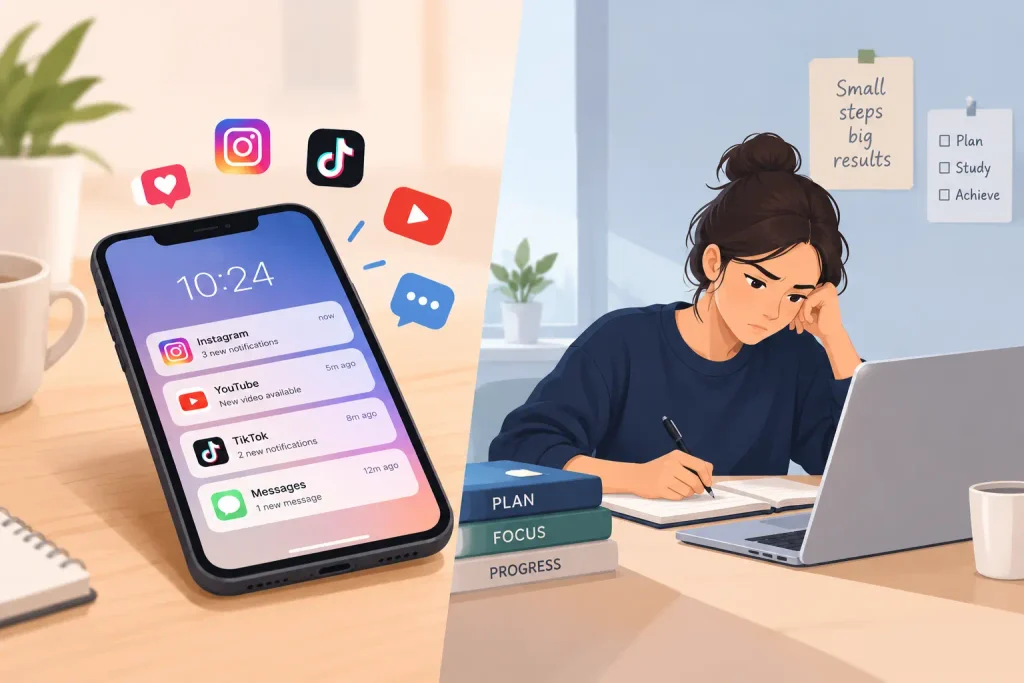
Dopamine is often described online as the pleasure chemical, but that explanation is too simple.
Dopamine is involved in several processes related to motivation, learning, reward, and the anticipation of rewarding experiences.
Research on dopamine has also explored its role in motivation and reward learning.
This becomes relevant when we think about procrastination.
Some activities provide rewards almost immediately. Social media feeds, short videos, games, notifications, and other forms of digital entertainment can provide frequent changes in information and stimulation.
A difficult task usually works differently.
Reading a complicated chapter, writing an article, exercising, studying, or working on a long project may require sustained effort before you experience a meaningful reward.
This does not mean that dopamine is being “used up” every time you use your phone, nor does it mean that your brain becomes permanently damaged by entertainment.
The more useful way to think about it is that our brains learn from repeated experiences.
If we repeatedly choose activities that provide quick rewards whenever we feel bored or uncomfortable, reaching for those activities can become an automatic response.
If you want to understand dopamine in more detail, you can read What Does Dopamine Do? How It Affects Motivation, Reward, and Focus.
Can Too Much Stimulation Make Ordinary Tasks Feel Boring?
This is where one of my own observations about procrastination comes in.
Modern life gives us access to an enormous amount of stimulation. We can move from one video to another, receive messages instantly, switch between applications, listen to music, play games, browse social media, and consume new information almost continuously.
There is nothing inherently wrong with these activities.
The problem can arise when highly stimulating activities become our default response to every moment of boredom.
Imagine spending several hours moving between highly engaging pieces of content. Later, you sit down to read a difficult book.
The book may not suddenly have become less valuable. But compared with the constant novelty you were experiencing earlier, it may feel slow. From my own experience, I have noticed that after spending a lot of time consuming highly stimulating content, it can sometimes become harder to retain what I am reading. I may find myself rereading the same lines because my attention keeps drifting instead of fully processing the information.
That difference can make it harder to settle into an activity that requires patience.
This does not mean that stimulation simply drains a fixed supply of brain energy or that dopamine becomes depleted.
A better explanation is that repeated patterns of attention and reward can influence our habits and what we naturally reach for when we feel bored or uncomfortable.
Over time, we may become accustomed to frequent stimulation and find slower activities harder to start.
This is an area where more nuance is important. The relationship between digital media, attention, motivation, and behaviour is complex and depends on the type of activity, the individual, and how it is used.
Why Difficult Tasks Are So Easy to Avoid

Another important part of procrastination is the task itself.
Some tasks are naturally difficult to begin.
They may be boring, confusing, mentally demanding, uncertain, or connected with the possibility of failure.
Your brain may respond to this discomfort by looking for something easier.
Instead of writing the first paragraph, you check your phone.
Instead of starting the assignment, you organize your desk.
Instead of making the difficult phone call, you decide that you will do it later.
The alternative activity does not necessarily have to be enjoyable. It simply needs to feel easier than the task you are avoiding.
This is why procrastination can happen even when you genuinely care about the goal.
You may want to become healthier but still avoid exercising.
You may want to learn something new but keep delaying the first lesson.
You may want to finish an important project but repeatedly find small distractions.
The problem is not always a lack of desire for the final result.
Sometimes the immediate experience of doing the task feels harder than the immediate alternative.
Why We Procrastinate on Things We Actually Want to Do

One of the most confusing forms of procrastination is delaying something that you genuinely enjoy.
You may have a hobby you love, a personal project you are excited about, or a skill you want to learn.
Yet you still keep putting it off.
This can happen because wanting something in the long term and wanting to do it at a particular moment are not exactly the same thing.
For example, you might genuinely want to learn photography. You may imagine yourself becoming better at it and enjoy the idea of taking great photographs.
But when it is time to sit down and learn the technical side, the activity may require concentration and effort.
Suddenly, checking your phone feels easier.
This is why asking yourself only, “Do I want this?” may not explain procrastination.
A better question can sometimes be:
“What makes starting this task feel difficult right now?”
That question can reveal whether the problem is boredom, uncertainty, distraction, fear of doing something badly, mental fatigue, or simply not knowing where to begin.
The Role of Mental Fatigue and Attention
Your ability to maintain attention is not unlimited.
After spending a long period switching between tasks, processing information, responding to messages, and making decisions, concentrating on one demanding activity can feel more difficult.
This is especially relevant when your environment is full of interruptions.
Every notification does not necessarily destroy your concentration, but frequent interruptions can make sustained attention harder.
If you are constantly switching between your phone, computer, messages, videos, and work, you may spend less time deeply engaged with any single task.
This connects closely with the topic of focus. If you often struggle to maintain attention, you can also read [Why Can’t I Focus on Anything? The Science Behind a Distracted Mind].
How Can You Stop Procrastinating?

Understanding procrastination is useful, but eventually the important question becomes what you can do about it.
You do not need to completely remove entertainment from your life.
The goal is to make it easier for your brain to begin the activities that matter.
Make the First Step Extremely Small
Instead of telling yourself that you need to finish an entire project, focus only on the first action.
Open the document.
Write one sentence.
Read two pages.
Study for ten minutes.
Starting is often harder than continuing.
Once you begin, the task may feel less difficult than it did while you were thinking about it.
Reduce Easy Distractions
If your phone is beside you while you are working, you are constantly surrounded by an easy source of stimulation.
Put it somewhere that requires physical effort to reach.
Turn off unnecessary notifications.
Close tabs that are unrelated to your task.
The goal is not perfect concentration. It is simply to make the distracting option less automatic.
Give Yourself Fewer Sources of Constant Stimulation
You do not need to stop watching videos or using social media.
Instead, pay attention to how often you use highly stimulating activities whenever you experience even a small amount of boredom.
Try allowing yourself periods where you are not constantly consuming new information.
Take a walk without your phone.
Read a physical book.
Sit quietly for a few minutes.
Do one task without switching between several others.
These simple changes can make slower activities feel more comfortable over time.
Make Physical Activity Part of Your Routine
One thing I have personally found helpful is staying physically active. Whether it is exercise, walking, or simply getting up and moving throughout the day, physical activity has helped me feel more active and less drawn toward distractions.
I have also noticed a difference in my mental clarity. When I spend too much time sitting and consuming content, I can feel mentally sluggish and find it harder to stay focused. Being physically active, on the other hand, has helped me feel more alert and present, which makes it easier to return to tasks that require attention.
This made me realize that physical activity is not only about changing how your body looks. For me, it has also become a way of taking care of my mental state. Moving more throughout the day can create a break from screens and constant stimulation while giving your mind a chance to reset.
Of course, this is based on my personal experience, and the effect can be different for everyone. But if you find yourself spending most of the day sitting, scrolling, or jumping between different forms of entertainment, adding some physical movement to your routine may be worth trying.
Create a Clear Starting Point
Vague plans are easy to postpone.
“Work on my project” is not very specific.
“Open the document and write the introduction” gives your brain a clear starting point.
The more clearly you define the first step, the less mental effort you need to spend deciding what to do.
Do Not Wait Until You Feel Motivated
One of the biggest mistakes is waiting for motivation to appear before starting.
Motivation can change throughout the day.
Sometimes action comes first and motivation follows.
You begin with five minutes, become more engaged, and then continue for longer than expected.
The goal is not to feel motivated before every task.
The goal is to make starting easier even when motivation is low.
Procrastination Is Not Always About Laziness
Procrastination is often described as laziness, but that explanation leaves out many important factors.
A person may procrastinate because a task feels overwhelming, boring, uncertain, emotionally uncomfortable, or difficult to start.
Constant distractions and highly stimulating environments may also make it easier to escape from tasks that require sustained attention.
Understanding these factors does not mean removing personal responsibility.
It simply gives us a better starting point for changing the behaviour.
Instead of asking yourself, “Why am I so lazy?” try asking:
“What am I avoiding, and what makes starting this task difficult?”
That question can lead to a much more useful answer.
Final Thoughts
So, why do I procrastinate so much?
There is rarely one simple answer.
Procrastination can involve reward, motivation, emotions, attention, habits, mental effort, and the way we respond to uncomfortable tasks.
Our modern environment can also make immediate stimulation extremely easy to access. When we constantly choose quick rewards whenever we feel bored, it may become harder to settle into activities that require patience and sustained effort.
But this does not mean that your brain is broken or that you have permanently damaged your ability to focus.
Small changes can make a difference.
Reduce unnecessary distractions. Make important tasks easier to start. Give yourself fewer opportunities to escape into constant stimulation. Most importantly, stop waiting for the perfect feeling of motivation before taking the first step.
Sometimes the best way to overcome procrastination is simply to make the first step small enough that you no longer need to argue with yourself about starting.