

You sit down to do something that actually matters to you. Maybe you need to study a difficult chapter, finish an important piece of work, or finally make a decision you’ve been putting off.
You read the first few lines.
Then you realize you barely remember what you just read.
You go back and read it again. Your thoughts jump to something else. You check your phone. You come back to the task, only to find yourself staring at the same sentence again.
Yet there are other days when the exact same kind of work feels surprisingly easy. Your thoughts seem more organized. You understand what you’re reading. You know what needs to happen next.
So, what is mental clarity, and why does it seem to disappear on some days?
Mental clarity isn’t about having a completely quiet mind. It has more to do with how well you can organize your thoughts, direct your attention, hold information in mind, and work through something without constantly losing track of it.
And neuroscience gives us some useful clues about why that ability can change from one day to another.
What Does Mental Clarity Actually Mean?
In simple terms, mental clarity is the ability to think in an organized and manageable way.
You can hold onto the main idea of what you’re doing. You can sort through information without feeling completely overwhelmed. You can make a decision, follow a train of thought, or work through a problem without constantly losing your place.
But there is an important detail here.
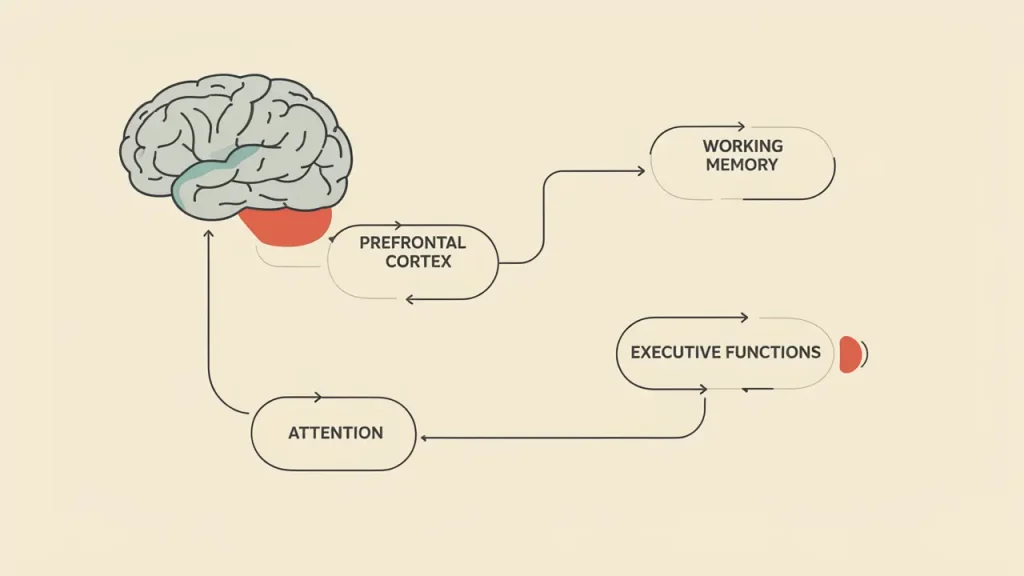
Mental clarity isn’t a formal medical diagnosis or a single measurable brain function. Researchers don’t have one test that simply measures “clarity.” Instead, the experience of clear thinking overlaps with several cognitive processes, including attention, working memory and executive functions.
So when someone says, “My mind feels clear today,” they’re usually describing a combination of these processes working reasonably well together
Mental Clarity vs Focus, Attention and Concentration
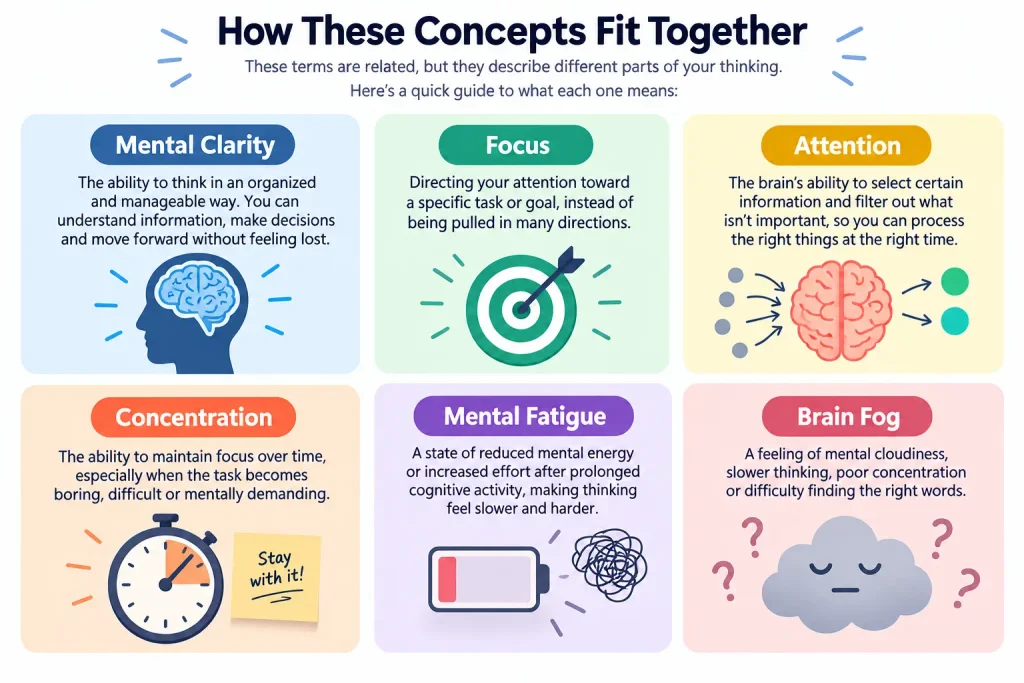
These terms are often used interchangeably, but they aren’t exactly the same. Attention is the ability to select certain information for processing while other information receives less priority. A loud sound, for example, can capture your attention even when you weren’t trying to listen to it. Focus is more about directing your attention toward a particular target, while concentration involves maintaining that focus over time, especially when the task becomes boring, difficult, or mentally demanding.
Mental clarity is broader. It isn’t just about staying focused. It’s also about being able to organize your thoughts, understand what you’re trying to do, and work through problems without feeling mentally overwhelmed.
A simple way to think about the difference is this: focus asks, “What am I paying attention to?” while mental clarity is closer to asking, “Can I think through this clearly?”
Mental Fatigue and Brain Fog
Mental fatigue and brain fog are related to mental clarity, but they aren’t identical.
Mental fatigue generally refers to the feeling of reduced mental energy or increased effort after sustained cognitive activity. After several hours of demanding studying, problem solving or decision making, you may notice that thinking takes more effort than it did earlier.
Researchers still debate exactly why mental fatigue occurs and how all of its mechanisms fit together, so it’s better not to reduce it to one simple explanation.
Brain fog is even less specific. It’s an everyday phrase people use to describe experiences such as feeling mentally cloudy, having difficulty concentrating, thinking more slowly, or struggling to find the right word.
That means someone can experience mental fatigue without describing it as brain fog, and someone can describe brain fog without simply having worked for several hours.
Both can make clear thinking more difficult, but they describe different experiences.
The Brain Systems Behind Clear Thinking
Mental clarity doesn’t come from one specific “clarity center” in the brain.
Instead, it depends on several interacting cognitive systems. Three ideas are particularly useful for understanding it: executive functions, working memory and attention.
Executive Functions and the Prefrontal Cortex
Executive functions are the mental skills that help you manage goal-directed behavior.
They include things like:
– Planning what to do next
– Keeping a goal in mind
– Prioritizing information
– Resisting distractions
– Switching between tasks when necessary
– Monitoring whether you’re actually making progress
A useful way to picture executive functions is as the brain’s management system.
The prefrontal cortex, located toward the front of the brain, plays an important role in several of these processes. However, it doesn’t work alone. Clear thinking depends on communication between multiple brain regions and networks.
Research on executive attention has linked prefrontal systems with maintaining goals and controlling attention, particularly when there are competing sources of information.
This helps explain why mental clarity can feel less like “having more intelligence” and more like being able to keep your thoughts organized around what actually matters.
Working Memory and Cognitive Load
Working memory is often described as the brain’s mental workspace.
Imagine reading a sentence. You need to hold the beginning of the sentence in mind while processing the rest of it. Or imagine solving a problem where you need to remember an earlier step while working on the next one.
That’s working memory in action.
But working memory has limitations. It isn’t an unlimited storage space where you can keep adding information without affecting performance. Research on working memory has consistently examined the limits imposed by interference and the amount of information that can be actively maintained.
This is where cognitive load becomes relevant.
If you’re trying to write while remembering three other tasks, checking notifications, worrying about an unfinished assignment and keeping several browser tabs open, your mind is dealing with more competing information.
The result can feel like mental clutter.
You can’t simply expand your working memory whenever you feel overwhelmed. But you can reduce some of the unnecessary demands placed on it.
And that idea becomes important when we get to the practical strategies later.
Attention and the Ability to Stay on Track
Attention is another important part of clear thinking.
At any given moment, your environment contains more information than you can consciously process. Your brain has to prioritize some information while filtering out other signals.
That becomes especially important when you’re trying to work toward a specific goal.
If you’re reading a difficult article while notifications keep appearing, part of your attention is repeatedly being pulled toward those interruptions. Even when you return to the article, you may need a moment to reconstruct where you were and what you were thinking.
This is one reason why mental clarity and sustained attention are closely connected.
What Is Mental Clarity? What Does It Feel Like?
Sometimes it’s easier to recognize mental clarity when you describe the experience. You may notice that you can read something once and understand the main idea without repeatedly going back over the same sentence. You can explain a thought to someone without losing track of what you were trying to say, and you can work through a problem without jumping between five different thoughts every few seconds.
You may also find that you can compare two options and make a decision without feeling as though every possibility is competing for your attention at once. And perhaps most importantly, you can notice when your attention wanders and bring it back.
That last part matters. Mental clarity doesn’t mean your mind becomes completely silent. Thoughts will still appear. You may remember something unrelated halfway through a task or suddenly think about a conversation from yesterday.
Clear thinking isn’t the absence of distraction. It’s being able to return to what you’re doing without getting completely pulled away by every thought that appears.
Why Does Mental Clarity Decrease?
Mental clarity can change for many reasons, and not every explanation has the same amount of scientific evidence behind it.
Some factors, such as insufficient sleep and acute stress, have substantial research behind their effects on aspects of cognitive performance. Others, such as the feeling of being overwhelmed by constant information, are more complicated.
Sleep, Stress and Mental Effort
Sleep is one of the clearest factors to consider.
A systematic review and meta-analysis published in 2024 found that even a single night of restricted sleep was associated with greater sleepiness and poorer sustained attention, although effects differed across cognitive measures.
More recent research has also found that sleep loss can affect several components of executive function, including working memory and aspects of cognitive flexibility.
This helps explain why a task that normally feels manageable can suddenly seem much harder after a poor night’s sleep.
Stress can affect cognition as well.
Research on acute stress has found effects on executive functions such as working memory and cognitive flexibility, although the relationship isn’t as simple as saying that every amount of stress makes thinking worse.
If you’re trying to concentrate while your mind is repeatedly returning to a problem you’re worried about, some of your mental resources are being occupied by that concern.
That can make organizing your thoughts feel harder.
Then there’s simple mental effort.
After spending a long time solving difficult problems, studying or making decisions, you may notice that thinking becomes more effortful. That’s one reason mental fatigue can feel like a loss of clarity even when nothing else about your environment has changed.
Distraction, Task Switching and Information Overload
One of the easiest ways to make thinking feel scattered is to repeatedly move between tasks.
You write two sentences.
You check a message.
You return to the document.
You open another tab.
You remember something you need to search for.
Then you return to the original task.
It may feel like you’re doing several things at once, but cognitive research shows that switching between tasks can create measurable performance costs. People are often slower or more error-prone immediately after a task switch than when continuing with the same task.
That’s why “I’ll just check this quickly” can be more disruptive than it seems.
Your attention has to reorient itself.
Information overload can create another problem. When too much information competes for limited cognitive resources, it becomes harder to determine what deserves priority. Working memory limitations are one reason cognitive load can interfere with processing and learning when demands become too high.
Digital devices are worth discussing here, but with some caution.
It would be too simplistic to say that phones or social media automatically damage your attention. Research on digital media and cognition is more complicated than that.
The more straightforward issue is interruption.
If notifications repeatedly pull your attention away from what you’re doing, maintaining a continuous train of thought becomes more difficult. This is also closely related to why maintaining focus can become difficult when you’re constantly switching between distractions.
Physical Activity and Daily Routines
Physical activity may also support mental clarity and cognitive performance.
From my own experience, strength training helps me manage stress better and maintain cognitive performance, while aerobic exercise seems to improve my mood, motivation, and overall sense of mental energy.
These are personal observations, so the effects can vary from person to person.
Your daily routine matters too. Irregular sleep, changing work schedules, and constant interruptions can make it harder to settle into demanding mental tasks.
The goal isn’t to create a perfect routine. It’s simply to remove some unnecessary friction and give your mind better conditions to focus
How to Improve Mental Clarity and Focus
If you’ve been wondering how to improve mental clarity and focus, the answer isn’t one magic technique.
Most useful strategies fall into two broad categories:
Support the conditions your brain needs to function well, and reduce unnecessary demands on your attention.
Protect Your Sleep First
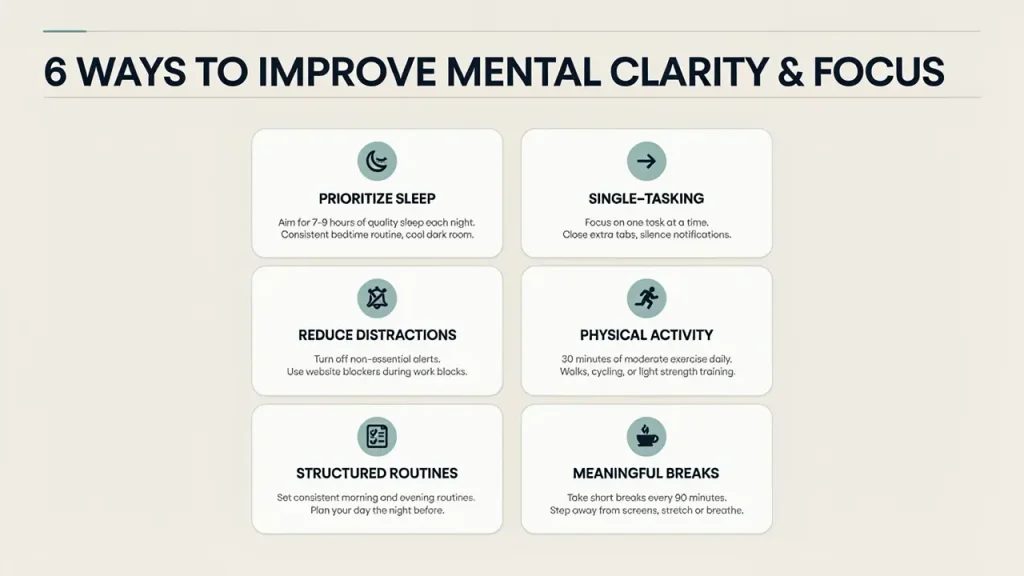
Sleep isn’t a productivity hack. It’s one of the basic conditions your brain needs for healthy cognitive functioning.
From my own experience, I have noticed that switching to low-stimulation activities after dinner, such as reading a physical book or an e-book, feels much better for my sleep than watching videos online. Video content can keep my mind engaged and stimulated when I am trying to wind down, while reading tends to feel more calming.
I also feel that keeping things calm after a meal gives my body a better chance to shift toward a rest-and-digest state, which supports normal digestion as the body prepares for sleep. Rather than continuing with highly stimulating content, giving yourself some quiet time after dinner may make it easier to wind down without interfering with your normal sleep routine.
Give One Task Your Full Attention
If task switching carries a cognitive cost, one practical response is to reduce unnecessary switching. Choose one task, close the tabs you don’t need, silence notifications, and put your phone somewhere that doesn’t constantly invite you to check it. The goal isn’t to become a productivity machine. It’s simply to make it easier for your attention to stay where you intentionally placed it.
If a random thought appears while you’re working, write it down rather than immediately acting on it. This gives you a way to remember the thought without allowing it to pull you away from the task you’re currently doing.
Break Large Tasks Into Smaller Decisions
“Work on the presentation” is technically a task, but it’s a vague one. Your brain still has to figure out what “work on” actually means. Instead, make the next action specific:
- Write the introduction
- Choose three main points
- Find one supporting source
- Create the first slide
This reduces the amount of thinking required just to figure out where to begin. It also gives you a clearer target for your attention.
For example, instead of simply telling yourself to “work on the presentation,” deciding to write the introduction first gives you a specific starting point and makes the task feel more manageable..
For more on why difficult tasks can be so hard to start, read our article on procrastination and the neuroscience behind it.
Take Breaks That Actually Give Your Mind a Break
Not every break is equally restful.
If you’ve been working on a difficult problem for an hour and then spend your entire break jumping between short videos, messages and notifications, you’ve changed the type of information you’re processing, but you haven’t necessarily given yourself much mental space.
Try something simpler.
Walk around.
Stretch.
Look outside.
Get away from the screen for a few minutes.
The ideal break length isn’t universal, and research on breaks varies depending on the task and context. The practical principle is more straightforward: after sustained mental effort, stepping away from demanding cognitive input can help you return with a fresher level of attention.
Move Your Body
Exercise doesn’t need to be extreme to be useful.
A walk, a short workout or regular aerobic activity can all be part of a healthy routine.
Research overall supports a relationship between physical exercise and aspects of cognition and executive function, although the size of the effect depends on factors such as the exercise type and duration.
So think of movement as part of the foundation for cognitive health rather than a switch that instantly turns mental clarity back on.
Make Your Environment Easier to Think In
Your environment doesn’t have to look like a minimalist productivity YouTube video.
It just needs to stop creating unnecessary competition for your attention.
Maybe that means:
– Keeping your phone out of reach
– Working with only the tabs you need open
– Using headphones when appropriate
– Keeping a notebook nearby for distracting thoughts
– Choosing a consistent place for demanding work
– Turning off nonessential notifications
The goal isn’t perfect silence.
It’s reducing the number of things your attention has to repeatedly defend itself against.
Mental Clarity, Focus and Productivity
There’s a common idea that productivity means fitting more tasks into the same number of hours. But sometimes the bigger problem isn’t the amount of time you have. It’s the amount of time you spend starting, stopping, rereading, deciding, checking, and restarting. You may spend twenty minutes “working” on something while your attention keeps moving somewhere else.
Mental clarity and focus support each other here. When your thoughts are organized, it’s easier to decide what deserves your attention. And when your attention stays with one task long enough, it’s easier to develop and organize your thoughts. Motivation can also influence where you direct your attention and effort.
If you want to understand the relationship between reward, motivation and focus in more detail, you can read: “What Does Dopamine Do? How It Affects Motivation, Reward, and Focus.”
The larger lesson is that productivity strategies work better when they respect the limits of human cognition. Working memory is limited, task switching has costs, attention fluctuates, and the brain needs periods of recovery. Those aren’t weaknesses you need to overcome. They are simply part of how your brain works.

When Should You Seek Professional Advice?
Everyone has days when thinking feels slower than usual.
A poor night’s sleep, a stressful period, or several hours of demanding work can temporarily affect concentration and mental clarity.
But persistent cognitive difficulties are different.
If problems with concentration, memory or thinking continue for a long time, become noticeably worse, or begin interfering with work, studying or everyday life, it may be worth speaking with a qualified healthcare professional.
The same applies if changes in thinking occur alongside other concerning changes in mood, sleep, energy or general health.
There can be many different reasons for persistent cognitive difficulties, including sleep problems, medication effects and physical or mental health conditions.
This article can’t determine which explanation applies to an individual person.
A professional evaluation can.
A Clearer Way to Think About Mental Clarity
So, what is mental clarity?
It isn’t a perfectly quiet mind. It doesn’t mean you will never become distracted, forget something, or struggle with a difficult problem. And it certainly doesn’t mean that some people simply have “clear minds” while everyone else is stuck with a foggy one.
Mental clarity is better understood as the ability to organize your thoughts, direct your attention, and stay connected to what you’re trying to do. That ability is influenced by things such as sleep, stress, cognitive load, interruptions, and physical activity.
You can’t control all of those factors every day. But you can notice which ones are repeatedly getting in the way. Maybe you need better sleep. Maybe your phone is interrupting you every few minutes. Maybe the task you are avoiding is simply too vague. Or maybe you have been asking your brain to work continuously without giving it enough time to recover.
Clear thinking doesn’t require fixing everything at once. Sometimes it starts with removing one unnecessary demand and giving your attention somewhere better to go.